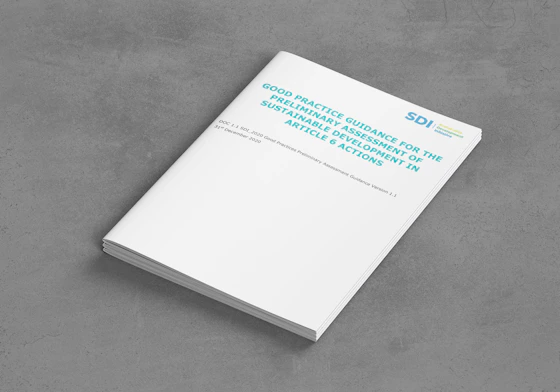
Article 6 and the Paris Agreement
The Paris Agreement represents a significant shift in international climate governance. All Parties have committed to Nationally Determined Contributions (NDCs), which are expected to increase in ambition over time with the aim of achieving a global balance between anthropogenic emissions and removals by 2050.
Article 6 provides the framework for voluntary cooperation between countries in implementing their NDCs. It establishes mechanisms through which mitigation outcomes can be transferred across borders, while requiring robust accounting to ensure that global ambition is not undermined.
Effective operationalisation of Article 6 is critical to maintaining environmental integrity, enabling market confidence and ensuring that international cooperation contributes to higher overall ambition.
The Three Pillars of Article 6
Article 6.2
Article 6.2 allows countries to cooperate directly through the transfer of Internationally Transferred Mitigation Outcomes. These transfers must be subject to corresponding adjustments to prevent double counting and ensure transparency in reporting.
This provision enables bilateral and multilateral agreements, including baseline and crediting systems and emissions trading schemes.
Article 6.4
Article 6.4 establishes a centralised UN mechanism, supervised at the international level, that builds on lessons from the Clean Development Mechanism under the Kyoto Protocol. It aims to deliver real, measurable and additional emission reductions while contributing to sustainable development.
Activities under Article 6.4 must meet defined requirements for additionality, monitoring, reporting and verification.
Article 6.8
Article 6.8 recognises non-market approaches that support mitigation and adaptation. These include cooperation through finance, technology transfer and capacity building, particularly for developing countries.
Why Integrity and Alignment Matter
Article 6 introduces new accounting and transparency requirements, including:
- Corresponding adjustments to prevent double claiming
- Clear authorisation processes by host countries
- Reporting, recording and tracking obligations under UNFCCC decisions
- Safeguards to protect environmental and social integrity
Without robust implementation, there is a risk of fragmented approaches, inconsistent accounting and reduced trust in international carbon markets.
Alignment to Article 6 therefore plays a central role in maintaining eligibility across markets and ensuring that cooperative approaches contribute to global mitigation rather than shifting emissions between countries.
Gold Standard’s Role in Supporting Article 6
Gold Standard supports governments, project developers and market participants in navigating Article 6 requirements through practical infrastructure and guidance.
This includes:
- Enabling host country authorisation of mitigation outcomes
- Labelling and tracking of authorised credits
- Transparent reporting aligned with UNFCCC decisions
- Safeguards to prevent double counting and double claiming
- Engagement with policymakers to promote clarity and consistency
Gold Standard also publishes annual information related to authorised mitigation outcomes to support Parties in meeting their reporting and tracking obligations.
Supporting Ambition and Market Confidence
Operationalising Article 6 is not solely a technical exercise. It is a governance and trust-building process that requires coordination between national authorities, standards, market participants and the UNFCCC process.
By aligning its requirements and infrastructure with Article 6 rules, Gold Standard seeks to:
- Safeguard environmental integrity
- Facilitate access to international carbon markets
- Support host countries in achieving their NDCs
- Provide clarity and confidence to buyers and investors
As international cooperation increases, coherent and transparent implementation of Article 6 will remain essential to ensuring that carbon markets contribute meaningfully to the goals of the Paris Agreement.