
Article 6 and CORSIA labelling - Step-by-step guide
This guide is for project developers implementing activities that are certified under Gold Standard for the Global Goals (GS4GG) and are seeking authorisation under Article 6 of the Paris Agreement. This authorisation is necessary for Gold Standard verified emission reductions (GSVERs) to be used under bilateral, country-to-country cooperative approaches, as well as for GSVERs to be retired by airlines to meet compliance obligations under first and subsequent phases of the Carbon Offsetting and Reduction Scheme for International Aviation (CORSIA). GSVERs may also be authorised and used for other purposes, such as voluntary corporate claims.
Introduction
This guide presents the step-by-step process that Gold Standard project developers should follow, from gaining the authorisation from the host country through to labels being applied to issued GSVERs in the Gold Standard Impact Registry. It should be read in conjunction with the following documents:
- Annex A of the GS4GG GHG Emissions Reduction & Sequestration Product Requirements (hereafter, GHG Product Requirements), which provides detailed requirements for GSVERs authorised under Article 6.
- Eligibility of Gold Standard VERs for use under CORSIA’s first and second phase (hereafter, GSVER CORSIA Eligibility), for project developers requesting to have GSVERs labelled as eligible for CORSIA.
- Labelling of credits and projects in the Impact Registry (hereafter, Impact Registry Labelling), to understand the different labelling options available for GSVERs.
This document may be periodically updated to reflect further guidance from the United Nations Framework Convention on Climate Change (UNFCCC) and findings of the Article 6 Technical Expert Reviews.
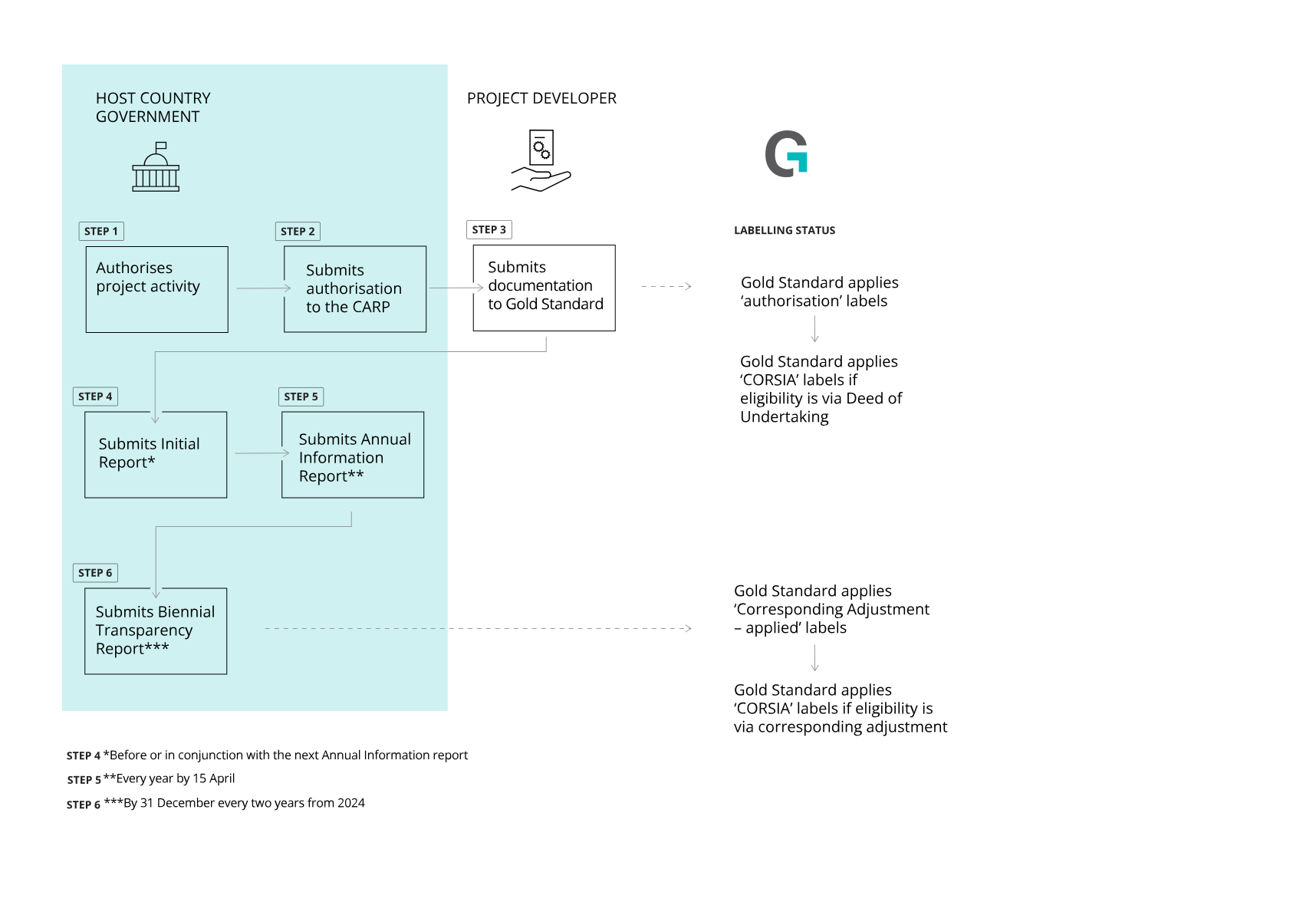
Step 1 – Receive an Authorisation of ITMOs from the host country government
An authorisation of internationally transferred mitigation outcomes, or ‘ITMOs’ (hereafter, ‘authorisation’), typically done via a letter of authorisation (LoA), affirms the host country’s commitment to account for the emission reductions or removals represented by GSVERs. The host country fulfils this accounting by applying ‘corresponding adjustments’. These adjustments are required to ensure that the emission reductions or removals are not counted towards two different climate targets.
- To learn more about what corresponding adjustments are, see this factsheet: GGGI, Understanding Corresponding Adjustments
The process to get an authorisation varies between countries. Some governments have established formal procedures as part of national carbon market frameworks, which applicants must follow. Often these frameworks will include standard authorisation templates. Where these are not in place, project developers should contact the country’s Article 6.4 Designated National Authority (DNA) as the first step. Contact details for each DNA are published by the UNFCCC. Where a national authorisation template is not available, the host country government or project developer may use the example provided by the secretariat of the UNFCCC.
Gold Standard has minimum information requirements for authorisation. Project developers should consult these before finalising the authorisation with the host country, to ensure all the necessary information is included. Gold Standard’s minimum information requirements are aligned with the requirements established under the UNFCCC. The minimum information requirements are listed in paragraph 1.3.2. of Annex A of the GHG Product Requirements.
Some governments may have multi-step processes for authorisation, for instance including an initial authorisation of an activity and a subsequent authorisation of ITMOs. Gold Standard requires the authorisation of ITMOs prior to labelling of GSVERs on its registry.
When requesting an authorisation, it is important for project developers to consider the following:
- If the GSVERs are intended to be sold for use by airlines in CORSIA, both the project and its GSVERs must be authorised by the host country for ‘other international mitigation purposes’ or for ‘international mitigation purposes’, which is a subset of the former. This authorisation may be required in addition to other authorised use cases. Only GSVERs that have the appropriate authorisation will have the option to be retired for CORSIA compliance use in the Gold Standard Impact Registry.
- For GSVERs authorised for ‘other international mitigation purposes’, the host country must specify when the ‘first transfer’ of the credits is considered to have occurred. This determines when the host country will apply corresponding adjustments. The host country has three options to choose from: when the GSVERs are authorised, issued, or used/cancelled.
The choice of when the ‘first transfer’ occurs has an impact on project developers who plan to sell their GSVERs for use by airlines in CORSIA. To be eligible to be used in CORSIA, authorised GSVERs must either have had a corresponding adjustment applied or be covered by a Deed of Undertaking and approved insurance policy that addresses the risk of double counting.
If the host country defines ‘first transfer’ as the point when the GSVER is used, corresponding adjustments will only be applied by the host country after the credit has been retired. This means these credits cannot be marked as eligible for CORSIA use in the Gold Standard Impact Registry unless the project is also covered by an approved insurance policy.
For more information on meeting eligibility requirements to sell GSVERs for use by airlines in CORSIA, please consult the GS4GG CORSIA Updates page.
project developer checklist
- Read Annex A of the GHG Product Requirements and Impact Registry Labelling documents
- If planning to sell credits under CORSIA, read GSVER CORSIA Eligibility document
- Request an authorisation from the host country government for the project activity(ies) and the issued GSVERs
- Ensure the authorisation contains the minimum information requirements listed in paragraph 1.3.2. of Annex A of the GHG Product Requirements
- Check that the authorised use cases in the authorisation are consistent with the intended end use for the GSVERs
Step 2 – The host country formally reports the authorisation
Once the host country has officially authorised the activity and resulting GSVERs, this must be formally communicated. Gold Standard accepts either/both of the following formal communications:
- Reporting via the UNFCCC’s centralised accounting and reporting platform (CARP). The CARP serves as a central repository for information relating to Article 6. Only country focal points have access to submit information to the CARP. Once the authorisation has been communicated it will be publicly available on the authorisations page of the CARP. Country focal points are responsible for submitting authorisations via the submission portal.
- Confirmation through the host country’s national registry system or a relevant third-party registry. Some countries may operate their own registry system to track their participation in Article 6. In this case, the project’s authorisation details will be listed on the national registry.
The project developer will need to submit evidence of either or both forms of formal communication prior to GSVERs being labelled as authorised in the Gold Standard Impact Registry (see Step 3). Formal communication by the host country has been introduced as a safeguard to demonstrate that the authorisation has been provided by the correct authority and that the relevant authority is ready to begin its tracking and reporting responsibilities under Article 6.
project developer checklist
- Ensure the authorisation has been published either on the CARP or on the national registry system
- Record the formal communication (eg the website URL)
Step 3 – Submit the relevant documents to Gold Standard
Once the authorisation has been formally communicated, the project developer is ready to submit the documents to Gold Standard. The project developer must submit the information listed below, which is also detailed in paragraph 1.2.1 of Annex A of the GHG Product Requirements. These documents must be submitted by using request type ‘Generic’ on the Gold Standard Assurance Platform:
a. A completed Article 6 Authorisation Checklist
b. A copy of the authorisation
c. Evidence of the formal communication of the authorisation via either the CARP or the host country’s national registry system
d. If the project developer wants the GSVERs to be labelled as eligible for use by airlines in CORSIA, one of the following:
- i.Evidence that corresponding adjustments have been applied for the authorised GSVERs, through the host country’s annual and biennial reporting (see Steps 5 & 6 below)
- ii.A signed Deed of Undertaking, supported by evidence that the GSVERs are covered by an insurance policy approved by Gold Standard, to address the risk that corresponding adjustments are not applied by the host country.
e. [If applicable] Where the project developer is applying to have labels applied to GSVERs that have been issued, a separate document containing the following:
- i. GS project ID(s)
- ii. Total number of GSVERs to be labelled
- iii. Serial numbers of GSVERS to be labelled
- iv.The labels that are requested to be applied
The project developer can submit this information at any time prior to the retirement of GSVERs that have received authorisation. It is important to note that only GSVERs representing emission reductions and removals achieved from 2021 onwards can be authorised under Article 6. Once the submitted information has been reviewed and approved by Gold Standard, both the Article 6 Checklist and the authorisation will be made public on the registry.
Labels are only applied to GSVERs that have been issued and are displayed on the relevant issuance pages. For labels to be applied, the project developer must submit the information listed in point (e) above. Gold Standard will then review the information and calculate the Article 6 labelling fee, based on the latest version of the Gold Standard Fee Schedule. Once this invoice has been paid, labels will be applied on the Gold Standard Impact Registry.
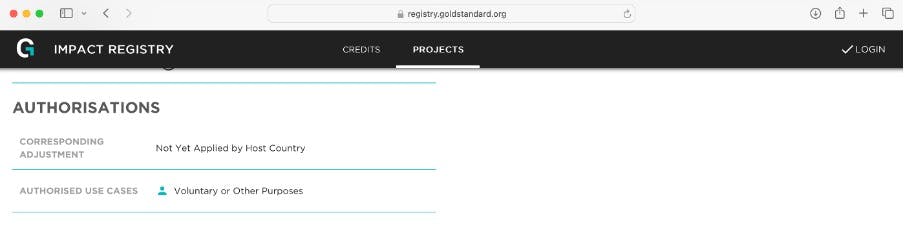
Image 1 – Example of Gold Standard Impact Registry issuance page for authorised credits
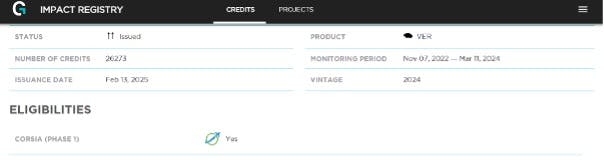
Image 2 – Example of eligibility label on the Gold Standard Impact Registry issuance page for authorised credits
Gold Standard reserves the right to remove authorisation and corresponding adjustment labels on GSVERs under certain circumstances. These include cases where the host country fails to meet the Article 6 participation requirements or if information reported to the UNFCCC by the host country is found to be incorrect through the technical expert review process. In such cases, Gold Standard will engage with the host country and project developer to try to resolve the situation, with the removal of labels a last resort in the event no resolution is reached. For further details on the timelines, consult Section 1.2 of Annex A of the GHG Product Requirements. Gold Standard will not remove its label to indicate that GSVERs are eligible for CORSIA’s first or subsequent phases, even if a host country does not apply a corresponding adjustment.
Host countries may also change their authorisation of projects, including revoking the authorisation entirely. At COP29, countries agreed that changes to authorisation must not affect credits that have already been ‘first transferred’, as per the host country’s definition (see Step 1 above), other than in cases where the terms and conditions for any changes have been agreed at the point of authorisation. If the host country revokes or modifies its authorisation, Gold Standard will update the labels in the Gold Standard Impact Registry to reflect the changes in authorisation status.
project developer checklist
- Submit the information listed in paragraph 1.2.2. of Annex A of the GHG Product Requirements to Gold Standard via a generic request on the Gold Standard Assurance Platform
- Where labels are to be applied to issued credits, also submit the information listed in point (e) of Step 3
- Pay the Article 6 labelling fee invoice
Step 4 – Host country submits its first – or updated – Article 6 Initial Report
Under the rules of Article 6, host countries must submit an ‘Initial Report’ outlining the cooperative approaches they are engaged in. All authorised GSVERs must come from a Gold Standard project covered by a cooperative approach. The project could either itself be a new cooperative approach or it could fall under the scope of an existing cooperative approach. Under UNFCCC rules, the host country must submit the Initial Report at the latest in conjunction with its next annual information report, which is due in April of the year following its initial authorisation and each April thereafter. This report may therefore be submitted after authorisation has been granted. See the template for the Initial ReportInitial Report
The Initial Report will be published on the UNFCCC’s reporting webpage. In cases where the authorised Gold Standard activity is not the host country’s first cooperative approach, the relevant information will be reflected in an updated Initial Report. Once the first or updated Initial Report has been submitted, the UNFCCC will allocate the cooperative approach(es) individual Cooperative Approach Identification (CA ID) number(s). The CA ID is necessary to complete the annual and biennial reporting requirements (see Steps 5 & 6 below). These are published on the UNFCCC’s cooperative approaches webpage.
For the project developer, it is important that the authorised activity has been accurately reflected in the Initial Report. Gold Standard will monitor countries’ Initial Report submissions as part of its ongoing due diligence checks, as outlined in the Annex A of the GHG Product Requirements.
project developer checklist
- Check that information related to the authorised Gold Standard activity is correctly reflected in the host country’s first or updated Initial Report
- Take note of the cooperative approach identification number (CA ID) allocated by the UNFCCC
Step 5 – Host country submits its annual information report
All countries participating in Article 6 must annually submit information related to their Article 6 activities. This annual information report is submitted in an ‘agreed electronic format’ (AEF), an Excel table template produced by the UNFCCC secretariat. The AEF template can be found on the UNFCCC’s webpage. The AEF for each calendar year must be submitted by 15 April of the following year. For example, data from the year 2026 must be submitted by 15 April 2027.
To support host countries in their annual Article 6 reporting, each year Gold Standard publishes an Article 6 Annual Report. This contains all the information from the previous calendar year relating to authorised Gold Standard activities on which the host country must report. If GSVERs from authorised projects were issued/or retired in the previous year, this will be communicated by Gold Standard in its Article 6 Annual report.
The project developer may also engage directly with host country government as part of the annual information reporting process. It is important that the AEF submission accurately reflects the project developer’s authorised activity, as Gold Standard relies on this information to verify the application of corresponding adjustments in the biennial transparency report (see Step 6 below).
project developer checklist
- Check that information related to the authorised Gold Standard activity is correctly reflected in the host country’s annual reporting in the AEF, especially:
- Excel tab Table 2 (‘Authorizations’) of the AEF
- Excel tab Table 3 (‘Actions’) of the AEF
Step 6 – Host country submits its biennial transparency report
Most countries that are party to the Paris Agreement must report on their progress every two years. This report is referred to as the ‘biennial transparency report’, or BTR. The BTR contains information on four main areas:
- Information to track the country’s progress towards meeting its nationally determined contribution (NDC) target
- Information related to climate change impacts and adaptation
- Information on support, including financial support, that the country provides
- Information on support, including financial support, that the country receives
The deadline for submitting the first BTRs was 31 December 2024, and the report is due every two years thereafter. The exception to this rule is for least developed countries (LDCs) and small island states (SIDS), which have flexibility in when they submit their BTRs. All BTRs and their annexed documents are published by the UNFCCC.
Due to the time lag in compiling greenhouse gas inventories, BTRs will typically report on emissions and removals from two years earlier. For example, the BTRs submitted in 2024 will report emissions data from 2021 and 2022, while the 2026 BTR will include emissions data from 2023 and 2024.
Countries participating in Article 6 are required to submit extra information related to their Article 6 cooperative approaches as part of the BTR. There are two main parts of this extra Article 6-related reporting:
- The Regular Information report, which is submitted as an annex to the BTR. Countries must report information on their cooperative approaches from the past two-year reporting period. The template for the Regular Information report is published by the UNFCCC.
- Quantitative information related to authorised Article 6 activities, reported in the 'structured summary'. The structured summary is a table provided by the UNFCCC in which countries report the progress they have made in meeting their NDC targets. The structured summary is typically reported in an Excel template referred to as the ‘common tabular format’ tables, or CTF tables.
It is through reporting in the CTF tables that corresponding adjustments are applied for authorised GSVERs that have been ‘first transferred’ in the latest reporting period. Gold Standard will review the CTF tables, supported by supplementary information provided in the Regular Information report, to verify that corresponding adjustments have been applied for authorised GSVERs. When verification is complete, the relevant GSVERs will be have the ‘Corresponding Adjustment – applied by Host Country’ label applied in the Gold Standard Impact Registry.
When reviewing the CTFs for evidence of the application of corresponding adjustment, Gold Standard requires certain minimum information to have been reported. This is shown below using Table 4 (‘Structured summary: Tracking progress made in implementing and achieving the NDC under Article 4 of the Paris Agreement’) of a template CTF report.
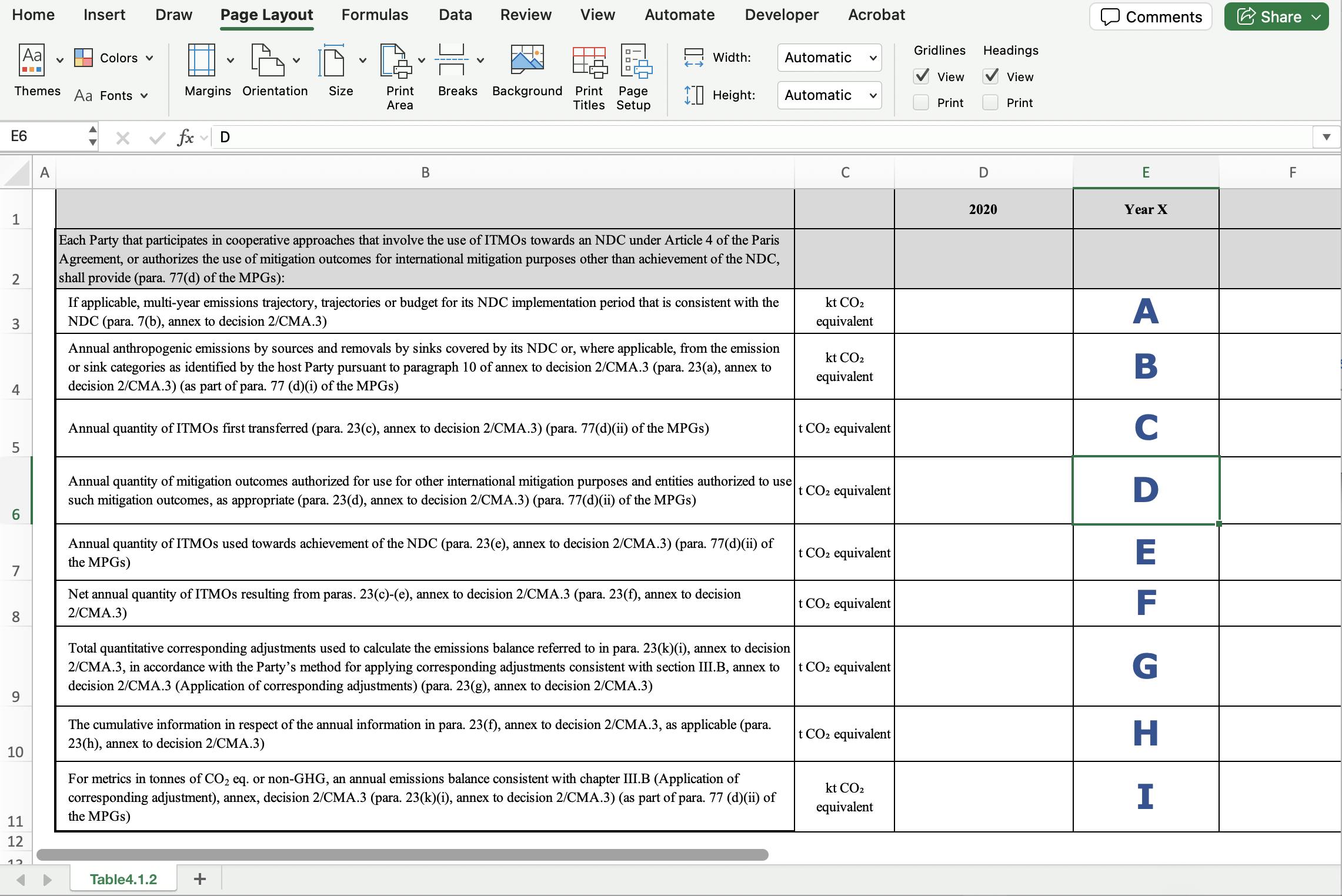
Image 3 – Example CTF template for reporting Article 6 information
Based on the above, for a Gold Standard project developer wishing to have a ‘Corresponding Adjustment – Applied by Host Country’ label applied to their issued GSVERs, the following standard process will apply:
1- The project developer submits a request for credit labelling via a generic request on the Gold Standard Assurance Platform.
2- Gold Standard will review the BTR/AEF/national registry information to verify that the authorised GSVERs have been reported on in a traceable way, using their unique serial numbers.
3- Gold Standard will review the country’s CTF reporting, checking that the GSVERs identified via the BTR/AEF/national registry information have been correctly reflected. At a minimum this must include evidence that:
i - The GSVERs have been included among the ‘first transferred’ mitigation outcomes, consistent with the host country definition of ‘first transfer’.
ii- The GSVERs included in the ‘first transferred’ mitigation outcomes have been included in the number of corresponding adjustments to be applied for the given year.
iii- An emissions balance has been reported, reflecting the country’s emissions level plus or minus the corresponding adjustment to be applied.
4- Gold Standard will apply a ‘Corresponding Adjustment – Applied by Host Country’ label to the relevant GSVERs in the Gold Standard Impact Registry. If the GSVERs have already been labelled as ‘authorised’, no additional fee is due to apply new labels. If the ‘Corresponding Adjustment – Applied by Host Country’ labelling request is submitted as the first Article 6 labelling request, Gold Standard will issue an invoice for the Article 6 labelling fee. Once the fee has been paid, the labels will be applied.
Gold Standard will conduct a monthly check for updated country reports. These checks align with reporting deadlines every April for the AEF and every second December for the BTR. If updated country reporting is available at any point, it may be brought to Gold Standard’s attention by contacting [email protected]. Once verified, the updated labels will be applied to the relevant GSVERs.
project developer checklist
- Check for the submission and publication of the BTR(s) of the countries in which your projects are located.
- Check that your authorised GSVERs have been included in the number in row C of the template CTF table. Given that the numbers reported in the CTF are aggregate figures, you may need to check the underlying carbon credit data in the BTR or AEF reporting/the host country registry to do this. Gold Standard will also do this as part of its review.
- [Optional] Inform Gold Standard when the BTR has been published.
- Submit a labelling request via the Gold Standard Assurance Platform
- Pay the Gold Standard Article 6 labelling fee (if not already paid)
Summary
Project Developer Action Checklist for Article 6 GSVERs