The Science Based Targets initiative’s (SBTi) Corporate Net Zero Standard 2.0 and forthcoming updates to the Greenhouse Gas Protocol will reshape how corporate climate action is defined, measured and communicated.

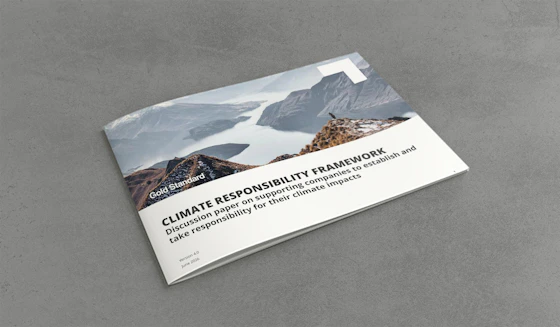
The latest edition of Gold Standard’s Climate Responsibility Framework responds to these changes, helping companies prepare rather than react.
Since its first publication in 2023, Gold Standard's Climate Responsibility Framework has served as a shared reference point for companies, institutions, and civil society seeking to build or critique credible climate strategies. The changes made in this edition are informed by shifts in international standard development, science, and hard-won lessons from companies putting climate commitments into practice, to support organisations to become positive, fair contributors to global net zero.
What’s new? From physical abatement to business model decarbonisation
The most substantive change in this edition concerns how the Framework approaches corporate emissions reduction targets. Previous editions centred on physical abatement: the direct reduction of emissions within a company's inventory across Scopes 1, 2 and 3. This remains the long-term overarching goal. However, this edition acknowledges a practical reality that previous versions did not fully address.
For many companies, full physical traceability or accessibility to every emission source is not feasible in the near term. A food company sourcing from thousands of smallholder farmers cannot always trace emissions to the exact source. A manufacturer may want to fund a critical zero-carbon technology that is not yet physically associated with its own supply chain. Under a strict inventory approach, these companies are left without a recognised pathway to act.
The updated Framework addresses this by splitting Principle 2 (the act of reducing the emissions from your business operations and supply chains) into two sections. Section 2.1 focuses on physical abatement as the priority and long-term goal. Section 2.2 introduces non-direct abatement: a structured, time-bound approach for companies to use implementation actions where direct physical traceability is not yet possible. Implementation actions might include working within an activity pool in the same sourcing region or using market instruments such as commodity certificates.
Implementation targets are a bridge, not a destination. They are time-bound, set on a 5-year basis, and companies are expected to progressively increase the association between their interventions and their emission sources.
Ongoing Emissions Responsibility
Version 4 of the Framework builds on its longstanding approach to Ongoing Emissions Responsibility (OER), previously known as Beyond Value Chain Mitigation (BVCM). Recent developments, including the SBTi Corporate Net-Zero Standard 2.0, have brought renewed attention to the role of climate action beyond the value chain. Alongside Gold Standard’s forthcoming report on OER, the Framework sets out an approach to OER and helps organisations understand how it can support both their transition plans and broader climate goals.
Corporate responsibility: New topics for discussion
The Framework also develops several themes:
- Implementation actions and performance: The Framework makes a distinction between meeting implementation targets and reducing a company's emissions physical inventory. Crucially, implementation actions do not necessarily reduce a company's own physical footprint. A company with a 100 tCO2e physical inventory of emissions that reduces three tonnes directly and addresses two more through implementation actions has a 97 tCO2e inventory, not 95. This means that they are fully responsible and meeting their target responsibilities, but it does not mean they are on track to meet their long-term targets. This is a critical distinction for the credibility of corporate target-setting and reporting. To be credible, implementation actions must be relevant, additional, and reported separately from physical abatement.
- From organisational net zero to contribution. The Framework explores an alternative way of thinking for corporate net zero: as a contribution to global net zero rather than a precise state of organisational neutrality. Organisation net-zero is derived from the global goals of the Paris Agreement. But companies are not states. They operate across globally distributed value chains and have differing levels of control and responsibility. Under a contribution framing, companies are responsible for both reducing their own emissions and supporting wider mitigation efforts. Their role is understood as contributing to a collective global goal. This can help remove competing incentives, simplify processes and claims, reduce the risk of double-counting and broaden possible investment types.
- A portfolio approach to carbon removal (CDR): Achieving net zero requires immediate and rapid scaling of CDR. The state of Carbon Dioxide Removal report (2024) estimates that durable CDR capacity may need to increase by up to 1,000-fold by mid-century1. The document sets out a portfolio approach, combining shorter-duration removals such as nature-based solutions for near-term climate impact, with longer-duration, low-risk CDR to build future supply, and R&D and enabling investments to support innovation and scaling. The share of durable CDR is expected to increase over time as technologies mature, costs fall, and we progress towards the net-zero target year.
- Short-lived climate forces (SLCFs): SLCFs such as methane, ozone and aerosols are responsible for an estimated 30–45% of current warming and offer significant near-term mitigation potential. The Framework encourages organisations to begin identifying and reducing SLCF emissions now, helping to deliver climate, health and social benefits while preparing for their likely inclusion in future climate frameworks and regulations.
- From ambition to credible action
Corporate responsibility is evolving, reflecting a more mature understanding of corporate action: not perfect accounting, but credible and transparent contribution to the global transition.
Companies that act now will be better positioned than those who wait.
1 Geden, O., Gidden, M. J., Lamb, W. F., Minx, J. C., Nemet, G. F., & Smith, S. M. (2024). The State of Carbon Dioxide Removal (2nd ed.). SWP, IIASA, MCC, University of Wisconsin–Madison, and University of Oxford.
Download the fourth edition of the Climate Responsibility Framework